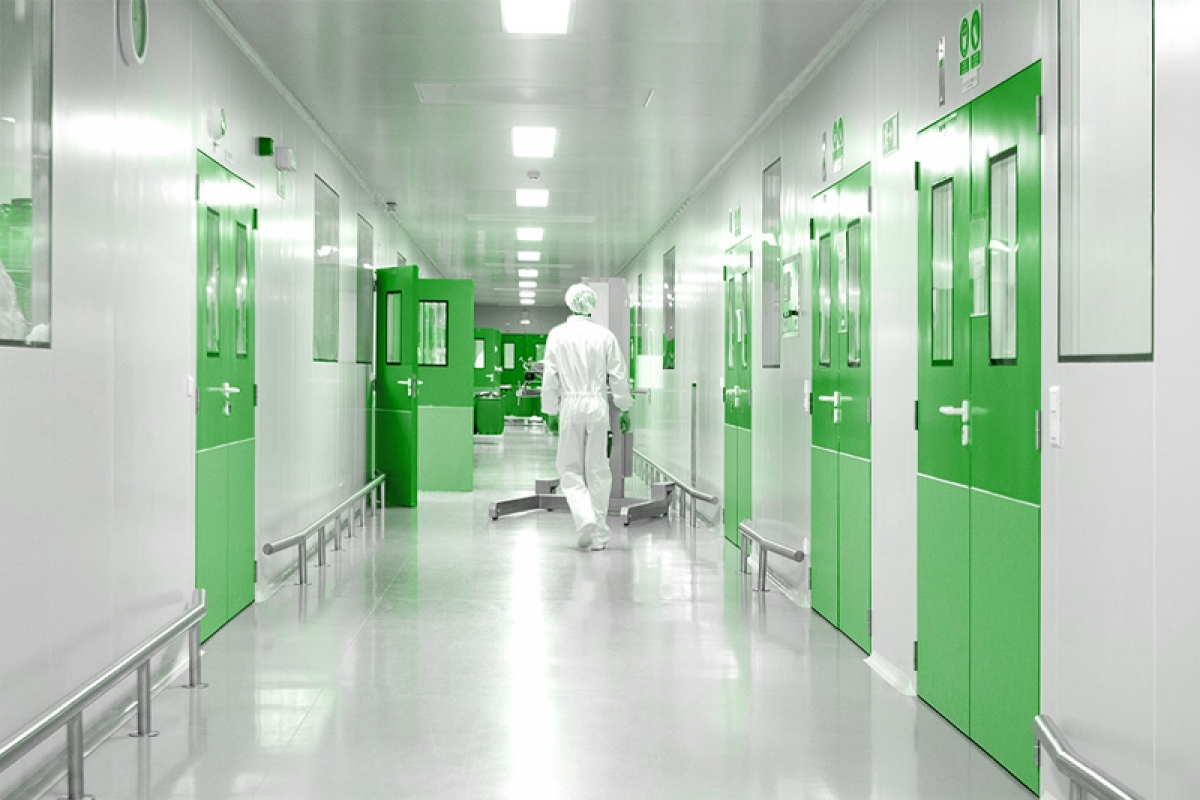
WHAT IS A CLEANROOM?
The primary goal of a cleanroom is to provide a space that regulates air quality and air changes and that has cleanable surfaces. The level of air quality is measured by the number of particles—dust, skin cells, microbial cells, etc.—that are present in a predefined volume of air and their size, measured in microns. This number is used to “classify” the level of the cleanroom. The lower the number and the fewer the particles present, the higher the classification level of the cleanroom. Conversely, outside (unfiltered) air contains on average approximately 35,000,000 particles per cubic meter.
While introducing clean air into an environment can lower the particle count in a space, it does not necessarily satisfy all of the requirements for a cleanroom. The materials, surfaces, and configuration of the cleanroom must be designed and built to allow the clean environment to be maintained. This includes implementing procedures for proper cleaning, cleaning chemicals, entering and exiting, gowning, and even movement within the space. Finally, temperature, humidity, and pressurization also play key roles in the function and maintenance of a cleanroom.
CLEANROOM CATEGORIES
Cleanrooms fall into three main industry categories:
MANUFACTURING
Nanotechnology, Electronics, Military, and Sterilization & Cleaning industries produce components that are extremely sensitive and require dust and particulate free environments to assemble. Additionally there are facilities that provide cleaning and sterilization to products for companies to use in their clean manufacturing areas. These can include lenses, laboratory equipment accessories, mirrors etc.
LABORATORIES
Research, Development and Testing are three types of labs that will require spaces with reduced Bioburden (the contamination from human skin or microbial cells) risk. Typically, these labs have living media or active pharmaceutical ingredients (“APIs”) that are being developed or tested for purity and consistency for uses in human medical treatments. If a QA test reveals that an API sample is contaminated, millions of dollars of product could be destroyed due to insufficient adherence to facility quality standards.
LIFE SCIENCES
Pharmaceutical, Bio-Technology and Food Manufacturing industries utilize cleanrooms in a similar fashion to labs, as their products are consumed by the public. Because some of their products, such as injectable drugs, surpass the body’s natural defenses when introduced into the body, pharmaceutical and drug industries typically have stricter regulations and clean standards.
CLEANROOM CONFIGURATIONS
Cleanrooms can be constructed in multiple different configurations, including stick built and modular. Stick built cleanrooms are permanent spaces constructed within facilities with the anticipation of utilizing the space for an extended period of time. They are usually built to suit the facility’s specific needs and can be customized during design. Stick built cleanrooms consist of typical construction materials, including metal studs, paper free gypsum board, stainless steel and cleanable finishes. They also often incorporate pre-manufactured wall and ceiling panels because of their quick installation time and cleanability. Wood products are not usually used in cleanroom design or construction.
Modular cleanrooms are pre-manufactured enclosures that are initially assembled off site before being transported and configured within an open area of an existing facility. These types of cleanrooms come in “hard” and soft” designs. Hard modular cleanrooms are typically a cube or rectangular shape, similar to a shipping container. The interior is cleanable and pre-assembled when it arrives on site. Some basic utilities might be included in its initial construction, but the majority of the utilities and modular units are installed, cleaned, and validated on site by the facility before use.
Soft modular cleanrooms are either inflated by air or use a light framing system with cleanable vinyl or another similar material for space separation. These types of clean areas are primarily used in industrial settings that do not require strict clean air standards. Occasionally, a soft cleanroom might be utilized in medical or HAZMAT emergencies for very specific, temporary uses.
CLEANROOM CLASSIFICATIONS
Cleanroom classification standards differ in different countries. The United States measures particles per cubic foot, while European standards measure per cubic meter. Regardless of the volume of air measured, the particle count standards remain quite similar worldwide.
The most common universal standard used is the International Organization of Standards (“ISO”). This universal standard creates a minimum set of requirements that must be met to have a cleanroom “classified” or recognized by authoritative regulatory agencies. ISO classifications range from ISO 9 (the lowest level of air quality or the highest particle count) to ISO 1 (the cleanest air quality or the lowest particle count).
Depending on the country or company, additional terminology may be used to describe a cleanroom. Organizations in the United States, for example, commonly use terms such as “Grade” and “Class” to describe the level of a cleanroom. “Grades” of cleanrooms usually range from A (the cleanest air quality) to D (the lowest level of air quality). Grade A cleanrooms are equivalent to an ISO 5 cleanroom or a Class 100 cleanroom.
ISO classifications lower than ISO 5 are primarily found in the electronic and life science industries. There are only a handful of ISO 1 classified cleanrooms in the world. These areas are so clean that they must have 10 or fewer particles per square meter over 3 microns in size and maintain between 500 to 750 air changes per hour.
Regardless of the terminology used, the particulate count limit is similar across the varying international standards.
AIR FLOW
Introducing clean air is only one part of maintaining a functional cleanroom. Air flow and air changes are important factors in reducing the amount of contamination that may be present.
Air is circulated through High-Efficiency Particulate Air (“HEPA”) filters that are designed to remove or capture particles that are larger than just a few nanometers (1 micron = 1,000 nanometers). For comparison, a human hair has the diameter of 75 nanometers, and the human eye can not detect particles smaller than 10 nanometers. Once the air has been filtered, the clean air is returned to the cleanroom in one of two ways: top down or horizontal.
Top down configurations consist of air supply diffusers in the ceiling with low-air-returns located close to the floor in the walls of the cleanroom. This creates a unidirectional airflow, keeping particles moving and continually providing clean air to the room. A specific type of top down air flow configuration, called Laminar, provides a “cone” of moving air to a specific area where added particulate protection may be needed for certain tasks. Many operating rooms, for example, use Laminar air flow designs.
In higher or “cleaner” classified areas, such as electronics manufacturing or sterilization service facilities, horizontal air flow configurations are typically used. As mentioned earlier, an ISO 1 cleanroom requires 500 to 750 air changes per hour, which means multiple air changes per minute. To achieve this, these cleanrooms are typically designed with lower ceilings and little unneeded space to reduce surface area and air volume. Depending on the complexity of the tasks in the cleanroom or equipment present, a 3D modeling software may be utilized by the design engineers to model the airflow. This will help the engineers identify dead spots, turbulent zones, and any other disturbances created by equipment or component configuration that could allow particles to settle instead of being removed through the low-air or horizontal returns.
MAINTAINING A CLEAN ENVIRONMENT
Similar to ISO classification requirements, ISO has a standard that sets minimum requirements for cleaning and maintaining a cleanroom. Although individual companies may have more stringent requirements, at a minimum, surfaces must be properly cleaned and only the accepted chemical solvents must be used in accordance with ISO standards.
It is necessary for any entity that wishes to maintain an ISO classified cleanroom to develop internal cleaning standards that meet ISO standards. To be accepted by regulatory agencies, these cleaning standards must be systematic, repeatable and documented. Employees should be trained in procedures and techniques that have been adopted by the cleanroom industry. Not abiding by cleaning standards may result in failure of audits by regulatory agencies and eventually, the loss of ISO classification.
REDUCING HUMAN IMPACT
The largest contributor to contamination in a clean environment is human beings. In addition to staff working in cleanrooms, contamination can occur when introducing materials or process components into the clean area. All cleanrooms should have standard operating procedures (SOPs) in place for cleaning, sterilizing and unpacking materials to reduce the risk of cross-contamination.
Similarly, staff that are working in clean environments should be trained to adhere to standards related to hygiene, gowning and reduced particulate-generating activities. Human-generated particulates include clothing fiber, skin and microbial cell shedding. Even when gowned appropriately, a person generates hundreds of thousands of particles per minute. For example, a person standing will generate approximately 100,000 particles per minute, a person walking will generate approximately 500,000 particles per minute, and a person walking up the stairs or using their full body will generate approximately 1,000,000 particles per minute.
It is impossible to completely eliminate human shedding within clean areas. However, the risk of contamination can be reduced with appropriate training and preparation before entering clean spaces. Standard risk-reducing behaviors might include slow, precise movements as well as avoiding coughing, speaking unnecessarily, whistling, etc.
Equipment such as Isolators and fume hoods further remove personnel contact with products where contamination can be a life safety concern. An Isolator is an enclosed area with its own air supply that personnel can access only via glove boxes or half-suits. A fume hood also has its own clean air supply, but personnel can access the controlled space directly.
It is also important to consider the number of people in a cleanroom at any given time. The more people present, the higher the Bioburden risk. Facility managers can avoid having redundant personnel in a cleanroom and provide staff training in a separate “mock-up” facility to greatly reduce the amount of particle shedding.