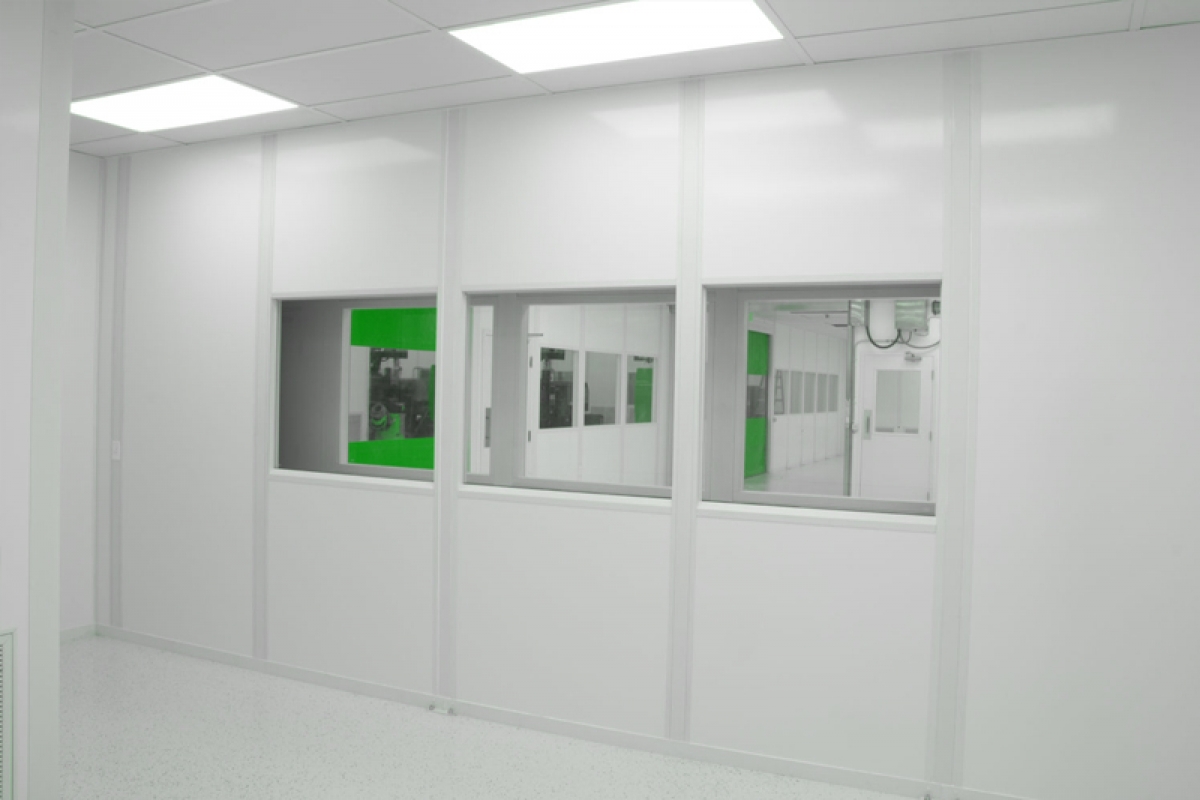
Simplify your cleanroom design process with our expert checklist, providing a clear roadmap to compliance with industry regulations, standards, and operational requirements.
Getting Started: Cleanroom Design Fundamentals
Determine Your Cleanroom Classification
Which class, regulation, or guideline must you comply with? Depending on your process and industry regulations, you’ll need to determine the ISO class for your rooms, considering guidelines such as USP, GMP, FDA, or internal quality policies. Higher air changes enhance cleanliness but increase costs. The ISO class impacts the design with GMP compliant cleanrooms requiring features like full flush design, coved corners, and monitoring systems.
Do you know the cleanliness level you need? Depending on your process and the regulations governing your field of work, you will need to determine the ISO class for your rooms. Sometimes ISO classes are enforced by a guideline (USP, GMP, FDA). Other times, they are defined by your company’s internal quality policy to improve product yield and decrease product defect rate.
Remember to keep it very basic. Higher air changes help remove more particles but also increase your initial project costs and daily operational fees. The ISO class impacts the design, so it is important to define it at the beginning. For example, GMP compliant cleanrooms require full flush design, coved corners, monitoring systems, airlocks, etc. Regulations will impact your cleanroom facility design and guide your answers to the questions in the below checklist.
- ISO 5? ISO 6? ISO 7? ISO 8?
- GMP Grade A, Grade B, Grade C, Grade D?
- 503 B (USP + GMP) ?
- USP 797, USP 800, USP 825?
Do you have a layout/sketch of your floor plan?
A well-designed layout is crucial for efficient access, material flow, and personnel movement. Consider input from architects, engineers, facilities personnel, and operators to establish material flows, pass-throughs, gowning zones, emergency exits, and mechanical rooms.
Cleanroom Design Details
The Cleanroom Shell / Envelope
1. What will you be doing in the room?
- Industry? Application? A high-level description of your process.
2. Which ISO class, grade, regulation or guideline must you comply with?
- Be cautious, over-specifying an ISO class/GMP grade will have substantial increases to your initial capital costs as well as your monthly energy bills.
- ISO 5? ISO 6? ISO 7? ISO 8? (per room)
- GMP Grade A, Grade B, Grade C, Grade D? (per room)
- 503B (USP + GMP)?
- USP 797, USP 800, USP 825?
3. What are the dimensions (length x width x height) of the classified rooms (clean spaces)?
- A rough sketch or more detailed layout drawing is very helpful!
4. To access all the information in this list, download our cleanroom design checklist.
5. Interlock system needed?
- An interlock prevents two doors from being accidentally opened at the same time. When a door is opened, the other doors are locked to maintain airlock integrity.
6. Window details
- Quantity and location? Ex: Windows every X feet on the outside walls (standard is a 36” window every 8’-12’)
- Flush mount (more expensive, cleaner appearance, easier to clean) or semi-flush with gasket
- Window Size?
- Window Shape?
7. Door details
- Quantity?
- Location?
- Door type? Single swing; double, swing; sliding door; high-speed roll-up door
- Window type and size?
- Automatic opening/touch-free opener (wave hand across sensor) or manual opening?
8. To access all the information in this list, download our cleanroom design checklist.
9. Pass-throughs and or cart-throughs (material handling)
- Our standard size is 24” x 24”; we can also do double-height or any custom size.
10. Cleanroom sink
- If needed – quantity, eyewash, shower?
11. Do you need coving?
- Coving eliminates 90° corners that are harder to clean. It can be done between wall corners and between the walls and the ceiling.
12. To access all the information in this list, download our cleanroom design checklist.
HVAC specifications, Operating Conditions, Ventilation System
How many people will work in your facility to meet your production needs? This information will not only be considered for access, interlocks, and number of interlocks but also with heat dissipation and sizing of your HVAC.
Any need for extraction in your rooms? Your hazardous process or a dust-generating manipulation might require you to extract air. If so, you will need to determine the equipment pulling the air out, its size, quantity, location, routing it to the outside, sizing its flow to plan impact on your overall balancing.
What is the electrical equipment generating heat gain? You need to plan the requirements of your process to consider the position of your equipment (mills, ovens, sterilization, freezers, etc.) to be powered for the position of electrical sockets.
13. Project Location
- The local weather influences the HVAC design. Even more so when a high percentage of fresh air is needed.
14. Is the cleanroom installed in an existing building or inside a new space?
- How many stories in the building? Cleanroom installed on what floor?
15. Average and maximum number of people working in the room at once?
16. To access all the information in this list, download our cleanroom design checklist.
17. What is the humidity setpoint and tolerance?
- Humidity ___% ± ___% (Standard is 45% ± 15%)
The Host Building
What space will we be working with? Are you installing your cleanroom in a warehouse, allowing suspended ducting and ease of service for your overhead equipment or are you converting an old office space with a low suspended tile ceiling? Is your space adjacent to a shipping dock or located above 5 flights of stairs?
18. Do you have any big production equipment in your room?
- Do you have any important latent heat source within the space (no dishwasher, autoclave, or other significant steam source?
- Do you have any big process equipment (heat sealing, welding baking, deep freezing) or higher voltage rated, dissipating sensible heat?
19. Is there room above the cleanroom for the ductwork? How many feet?
- Ideally, we need at least 4 feet or more.
20. Can the roof of your building support any additional load?
- We use load-bearing walls that require zero load capacity from the host building’s roof! But this is not the case for most of our competitors. Beware, an average cleanroom needs approximately 12-20 pounds per square foot of support from the existing facility roof (to support the cleanroom ceiling, ductwork, lights, HEPA filters, etc.) which represents a potential cost of $50,000-$250,000 in structural analysis and roof enhancements.
- Do you prefer your HVAC to be on the roof of the building or on the walkable ceiling of the cleanroom?
21. To access all the information in this list, download our cleanroom design checklist.
22. Overall height of the ceiling (from floor to bottom of the joists) in the building that the cleanroom is going into?
- Helps us understand working clearances.
23. Do you have a receiving dock in the building? How far is it from the receiving area to the cleanroom location? What floor is the project on? Any stairs or elevators needed?
24. To access all the information in this list, download our cleanroom design checklist.