Displaying items by tag: microelectronics
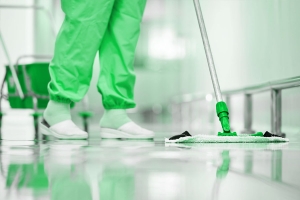
MicroElectronics Cleanroom Cleaning
Why clean the room? It’s a cleanroom, isn’t it? This was the most popular question when we began cleaning cleanrooms in 1980. Owners and operators often assumed that because their cleanrooms were equipped with state-of-the-art air filtration systems and other safeguards, normal cleaning procedures were optional or even unnecessary.
Microelectronics Cleanroom Construction
Product integrity and throughput suffers when airborne particles or volatile organic compounds (VOCs) invade microelectronics environments. Depending on the application, one particular size particle or contaminant characterization may be more problematic than another.
Adoption of microelectronics
As we move forward in an ever more tech-focused era, microelectronics technology is more pervasive, and has become an essential across varying industries. Life sciences and medical research have adopted microelectronics to help progress new ways of observing and treating an increasing number of injuries and conditions. For example, implantable medical devices are now routinely used in treatment.
Microelectronics Cleanroom Design
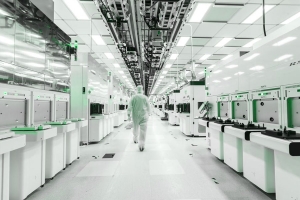
Due to the sensitive nature of their products, clean room facilities for microelectronic and semiconductor applications require stringent environmental controls. These clean rooms also house extremely precise and expensive equipment such as photolithography, etching, cleaning, doping, and dicing machines. Hence, any deficiencies in the cleanliness specifications can affect the entire production process. Other common issues in microelectronic & semiconductor clean room conception and design are the maximizing of space while also enabling future reconfiguration. For all these reasons, a modular clean room system is often the optimal solution.
Production of Microelectronics Cleanroom
Microelectronics technology is increasingly ubiquitous, even within the human body, as medical researchers develop new approaches to monitoring and treating a growing array of illnesses and injuries. A variety of implantable medical devices are now used routinely, ranging from intraocular lenses to electroencephalography (EEG) recorders and many others. The companies that design these devices require specific capabilities and qualifications from a potential medical device manufacturer. These requirements typically cover topics like experience in medical device manufacturing, the types of equipment necessary to manufacture, assemble and package the product, parts tracking methods, employee qualifications and/or specialised training, required industry and governmental certifications, etc. However, as comprehensive as these requirements might appear, some of them fail to include an aspect that’s critical for some categories of medical microelectronics device manufacturing: a microbial-controlled cleanroom.